
Pools
Best paving for a pool edge: 2026 guide
We compare the options for a pool edge (stamped concrete, porcelain, marble, stone carpet) on drainage, temperature and safety. An honest guide.
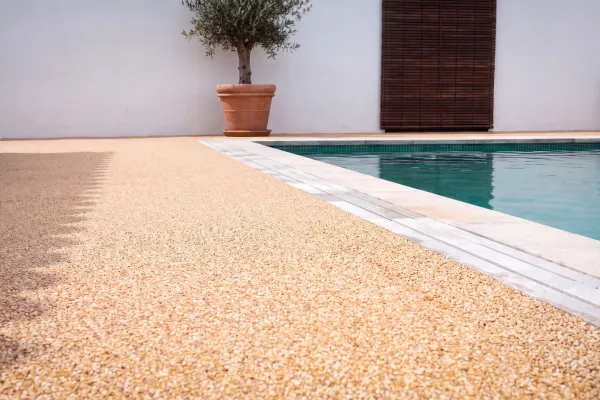
Stone carpet is a seamless flooring made of natural aggregate and resin that is applied over your existing floor. If you have searched for resin bound gravel or resin bound paving, you are talking about the same thing: those are the names this system goes by in the English-speaking market.
Unlike tiling, it is not laid piece by piece: it is spread as a mass of stone and resin that, once cured, forms a single-piece surface, with no joints, with the texture of the aggregate on show. The result is a floor that drains water away, does not burn underfoot in the sun and stands up to the Valencian outdoors without losing its look. In this guide we explain what it is, what it is made of and why it works where other surfaces struggle.
Several ways of naming the same material. Stone carpet is the industry technical term and the one manufacturers use; resin bound gravel and resin bound paving are the names most commonly used to search for it in English. Throughout this blog we use them interchangeably, because they describe exactly the same system: natural aggregate bound with resin to form a permeable surface.
Having several names causes confusion, but it is worth being clear before you ask for quotes: if one supplier talks about “resin bound gravel” and another about “stone carpet”, they are offering you the same product family. What changes between them is the quality of the aggregate, the type of resin and, above all, the workmanship (that is what makes it last).
The system has two components, and the result depends as much on the material as on the hand that applies it.
This is the property that best defines the system. Stone carpet is porous by construction: the resin only coats the aggregate and bonds it at the contact points, without filling the space between one grain and the next. Interconnected micro-gaps are left —what the industry calls a “no-fines” system— through which water passes through the surface from top to bottom instead of sitting on top.
That is why no puddles form at the pool edge and a patio does not flood in the rain: the water seeps through the surface and is drained away underneath. For the drainage to work properly, the substrate it is applied to needs the correct fall to carry the water to an outlet point; the surface drains, but the water needs somewhere to go.
That same porous nature explains why it copes well with frost: as it does not hold water on the surface, it does not build up moisture that would burst the material when it freezes, something the industry cites as one of its advantages over impermeable surfaces.
The process, simplified, is four steps:
Substrate preparation is, by far, the part that weighs most on the long-term result: good aggregate over a poorly prepared substrate ends up lifting. We cover it in the what stone carpet is section on the home page, and if you are coming from an old floor you will be interested in how to renovate a patio without building works.
If you are comparing it with the most common option in Valencia, you will be interested in stone carpet vs stamped concrete. And if cost is what’s on your mind, here’s how much stone carpet costs per m².
No. Microcement is a thin cement-based, impermeable coating applied to achieve a smooth, seamless finish; stone carpet is natural aggregate bound with resin and drains. Microcement does not let water through and has a smooth feel; stone carpet is porous and has the texture of the aggregate. They are different finishes with different properties, designed for different needs.
In many cases yes, over the existing substrate (tile, concrete, terrazzo) as long as it is sound, well bonded and free of damp problems. It depends on the state of the floor: if there are loose pieces, active cracks or damp, these have to be dealt with first. We assess it on the visit.
The colour depends on the chosen aggregate, within the available range. As it is natural stone, the tones are those of the stone itself (warm, neutral, grey), and they can be combined to achieve different finishes.
No: the exposed aggregate texture provides grip even when the floor is wet, which is exactly what you want around a pool. We expand on this in the best paving for a pool edge.
It needs little maintenance (sweeping and water) and, with good workmanship, a long service life outdoors.
Got a pool or patio in mind? Let’s talk and we will tell you honestly whether stone carpet fits your case. Tell us about your project.
We compare the options for a pool edge (stamped concrete, porcelain, marble, stone carpet) on drainage, temperature and safety. An honest guide.
The real differences between stone carpet and stamped concrete: drainage, temperature, joints, maintenance and building work. We help you decide without the sales pitch.
What influences the price of stone carpet per m²: total m², aggregate colour, state of the substrate and access. An honest guide to give you an idea before the quote.