
Technique & materials
What stone carpet is and what it is made of
Stone carpet, also known as resin bound gravel: what it is, what it is made of (aggregate + resin) and why it drains. Explained by specialists in Valencia.
If you are considering renovating an outdoor space in Valencia, the odds are someone has offered you stamped concrete: it is the most widespread option and the one you see most on driveways, yards and pool edges. Stone carpet (or resin bound gravel) is the alternative that competes with it most when what you want is a floor that drains and does not burn. They are not rivals in everything: each wins at different things. Here we compare them by what really shows in day-to-day use, without selling you the idea that one works for everything.
| Criterion | Stamped concrete | Stone carpet |
|---|---|---|
| Drainage | Impermeable: water runs off by the fall and sits on top | Drains through the material itself |
| Temperature in the sun | Heats up, especially in mid and dark tones | Does not store heat: porous aggregate, usually in light tones |
| Non-slip when wet | Depends on the mould and the sealer; can be slippery when wet | Yes, thanks to the exposed aggregate texture |
| Joints and cracks | Joints are a pattern; over time it can crack from shrinkage or settlement | Seamless and slightly flexible; no joints for dirt to gather in |
| Maintenance | Periodic resealing to maintain colour and grip | Sweeping and water; no joints for moss to grow in |
| Building work needed | Requires pouring a concrete base (or breaking up to make one) | Often applied over the existing substrate |
| System thickness | Concrete slab (several cm) | Thin layer of aggregate + resin |
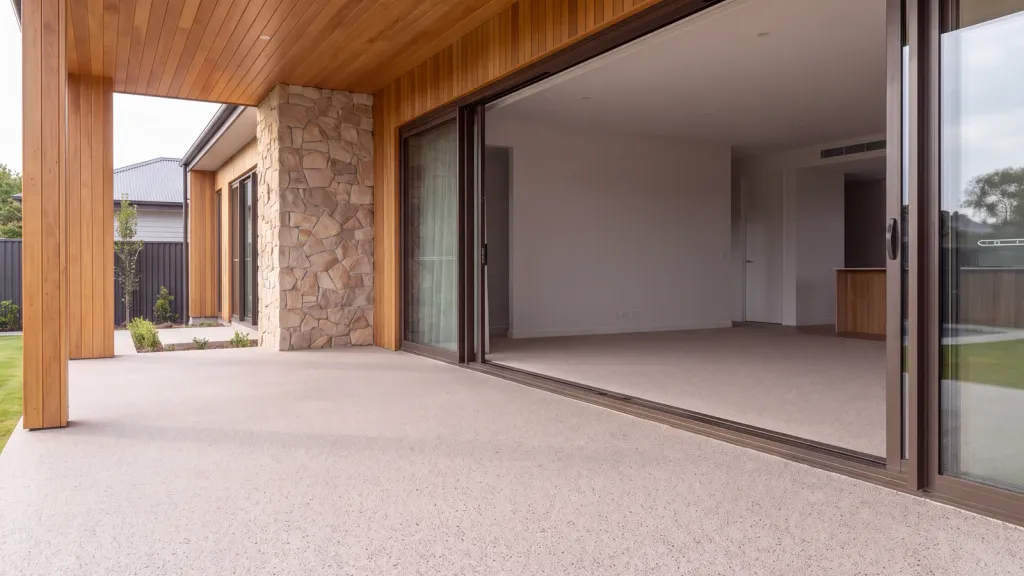
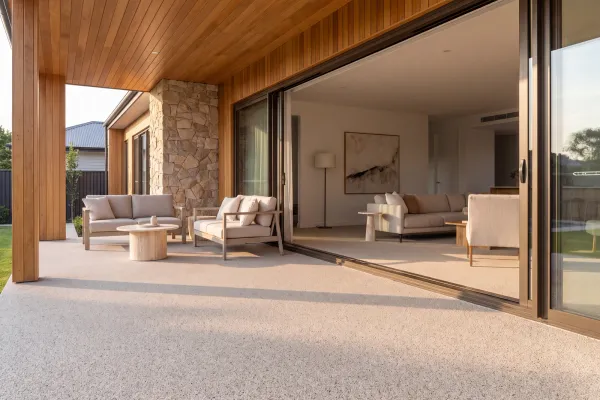
| Look | Printed finish imitating stone, wood or cobbles | Real natural aggregate, made-to-measure colour and stone-like look |
The characteristics in the table are those the industry generally attributes to each system; the actual behaviour depends on the quality of the product and, above all, on the workmanship.
This is the fundamental difference between the two systems, and the one that most changes the experience next to a pool. Stamped concrete is impermeable: water that splashes or falls stays on the surface until it runs off by the fall or evaporates. If the fall is not well resolved, puddles appear, and a puddle at the pool edge is exactly where you do not want one: it is slippery and encourages moss.
Stone carpet is porous by construction: the resin bonds the grains at their contact points and leaves interconnected micro-gaps, so the water passes through the surface from top to bottom. The edge stays dry without the slippery film of water that forms over an impermeable floor. That is why it stands out on pool edges; we expand on this in the best paving for a pool edge.
There is a permeable variant of stamped concrete (with coarser aggregate and less compaction) that improves water drainage, but it still does not match the porosity of an aggregate-and-resin system designed to drain, and it tends to need more demanding maintenance to avoid clogging.
On a Valencian August day, you notice the difference with your feet. Stamped concrete, as a mass of coloured concrete, stores heat: in mid and dark tones it can become uncomfortable to walk on barefoot. Stone carpet, with light-toned natural aggregate and a porous structure that does not store heat like a solid slab, stays cooler. As a general rule, in either of them the darker the colour, the more it heats up.
At an industry level, the two ask for different things:
Honesty is what makes a comparison useful. There is no absolute winner:
It is used on driveways and traffic areas, but bearing the weight and the turning of a vehicle requires a suitable system and thickness, as well as a sound substrate underneath. For heavy vehicle traffic, stamped concrete is a well-proven option. We assess it according to your case.
The key in both is the finish exposed to UV. In stamped concrete, the colour lives in a sealer that wears down and needs resealing. In stone carpet, the colour is that of the natural aggregate; what decides whether it does not yellow is the type of resin: in the industry, aliphatic resins (aliphatic polyurethane) are cited as stable against UV radiation.
Standard stamped concrete is impermeable and drains by the fall. There is a permeable version with coarser aggregate, but it does not reach the capacity of an aggregate-and-resin system designed to drain.
In many cases yes, if the concrete is sound, with no active cracks or damp, and well prepared. It is one of the common substrates. We assess it on the visit.
It depends on the area, the state of the substrate and the finish. Stone carpet often saves the work of the base by being applied over the existing floor; stamped concrete can be competitive over large new areas. We look at it in how much a stone carpet costs per m².
Not sure which fits your case? Let’s talk and we will tell you the truth about your floor, without pushing you toward what you do not need. Ask for a no-obligation quote.
Stone carpet, also known as resin bound gravel: what it is, what it is made of (aggregate + resin) and why it drains. Explained by specialists in Valencia.
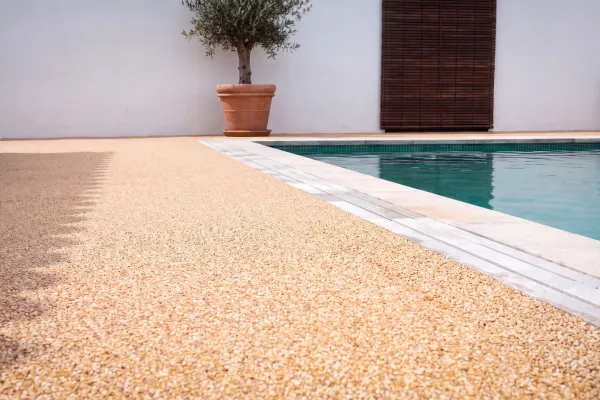
We compare the options for a pool edge (stamped concrete, porcelain, marble, stone carpet) on drainage, temperature and safety. An honest guide.
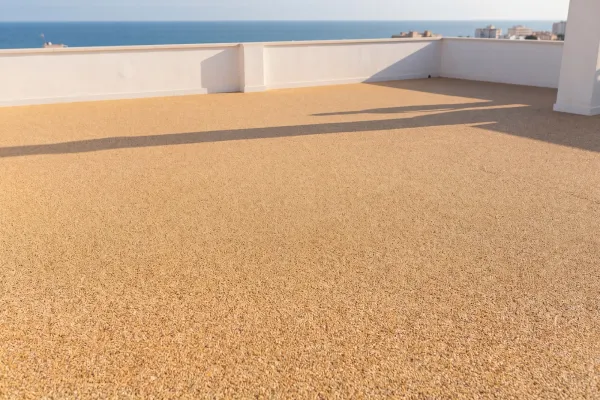
What influences the price of stone carpet per m²: total m², aggregate colour, state of the substrate and access. An honest guide to give you an idea before the quote.